
$148.00
$3.00
50% OFF! Hot items selling fast—Grab them before they're gone!

 Unconditional Satisfaction GuaranteeNo Shipping Fees Above 302 Months to Decide. Returns Simplified.
Acer japonicum Vitifolium is one of the most spectacular of the full moon maples, prized for its large, grapevine-like leaves and outstanding autumn colours. The name Vitifolium means vine-leaved, referring to the broad, lobed foliage that resembles that of a grapevine (Vitis).
This elegant Japanese maple is valued for its graceful shape and exceptional seasonal display, making it a choice specimen tree in gardens.
Foliage: Remarkably large leaves (up to 15 cm across) are broadly lobed and slightly serrated, giving them a bold texture. They emerge soft green in spring, deepen to fresh green through summer, and then transform into a spectacular blend of scarlet, orange and golden yellow in autumn, often with multiple colours on a single leaf.
Flowers: In spring, before or with the emerging leaves, small, hanging clusters of reddish-purple flowers appear, adding subtle charm.
Habit: Develops into a broad, rounded small tree or large shrub, typically growing to 35 metres high with a similar spread, creating an open, layered canopy.
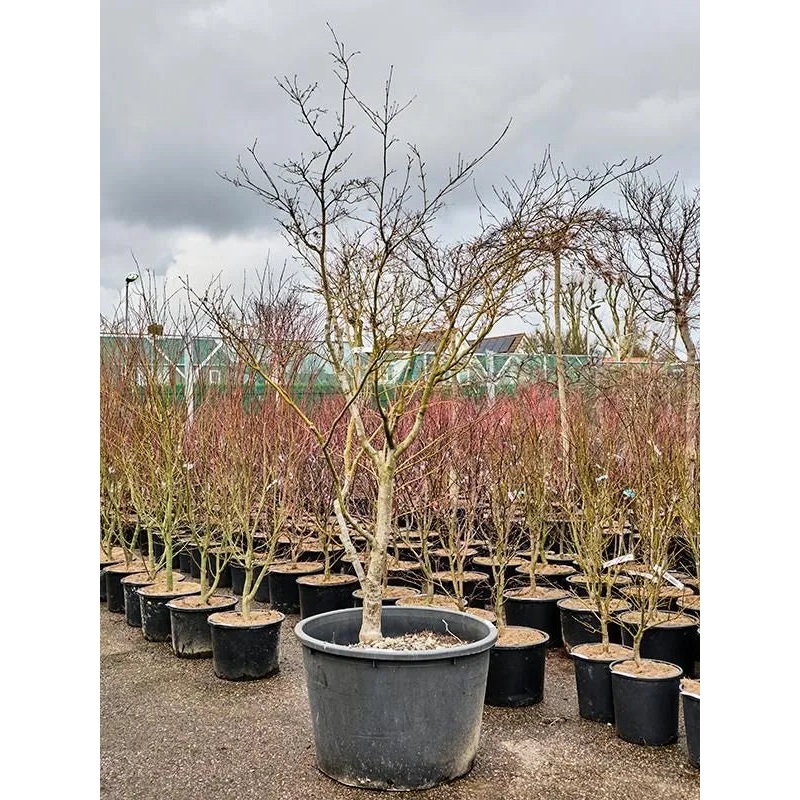
Bark: Smooth grey bark provides gentle winter structure.
Because of its large, dramatic leaves and brilliant autumn display, Vitifolium is an exceptional choice for planting as a specimen tree where it can be fully admired.
Prefers partial shade or dappled sunlight, especially in areas with hot summers.
Some morning sun is ideal to enhance autumn colour, but protect from strong afternoon sun to avoid leaf scorch.
Plant in a sheltered position, out of strong winds which can tear the large leaves and cause browning.
Likes soil to be consistently moist but well-drained.
Water deeply in dry periods, particularly when young or if grown in containers.
Mulch each spring with compost or fine bark to conserve moisture and keep shallow roots cool.
Prefers slightly acidic to neutral, fertile, humus-rich soil.
Avoid very alkaline or heavy clay soils. If necessary, plant in raised beds or containers using ericaceous compost mixed with grit for drainage.
Feed lightly in spring with a balanced slow-release fertiliser or a specialist acer feed.
Avoid high-nitrogen fertilisers which promote lush growth prone to wind and frost damage.
Requires minimal pruning.
Remove any dead, damaged or crossing branches in late autumn or winter while dormant.
Avoid hard pruning, which disrupts its graceful natural shape.
Generally very healthy and trouble-free.
May occasionally suffer aphids on new shoots.
Leaf scorch (browned edges) usually results from drought, wind or intense sun, rather than disease.
Suitable for large pots, making it ideal for patios or smaller gardens.
Use ericaceous compost with added grit, ensure good drainage by raising pots on feet, and water consistently.
In harsh winters, protect roots by wrapping the pot or moving to a sheltered location.


