
$23.99
$29.99
50% OFF! Hot items selling fast—Grab them before they're gone!

 Unconditional Satisfaction GuaranteeNo Shipping Fees Above 302 Months to Decide. Returns Simplified.
Calathea makoyana, commonly known as the Peacock Plant, is one of the most striking and graceful members of the Marantaceae family. Native to the tropical rainforests of Brazil, its celebrated for its exquisite, feather-like foliage that showcases natures artistry in every leaf.
Each elliptical leaf features intricate light green and cream patterns with bold, dark green ovals radiating from the midrib, resembling the elegant plumage of a peacock hence its name. The undersides are a rich purple-maroon, revealed each evening as the leaves gently fold upward in their characteristic prayer motion. Compact, elegant, and endlessly photogenic, Calathea makoyana brings a touch of the rainforests vibrancy and movement to any indoor setting.
Thrives in bright, indirect light. Direct sunlight can fade the leaf patterns or scorch the edges, while too little light may dull the colours. East-facing windows or filtered daylight through sheer curtains are ideal. It can tolerate moderate light but avoid deep shade.
Keep the soil consistently moist but not soggy. Water when the top 23 cm feels slightly dry, using filtered or rainwater to prevent fluoride and chlorine damage, which can cause leaf browning. Avoid letting the soil dry out completely, especially during warm months. In winter, reduce watering slightly but maintain humidity.
Temperature: Prefers warmth between 1828 C and must be kept away from cold drafts or air-conditioning vents. Avoid temperatures below 15 C.
Humidity: High humidity (6080%) is essential. Mist regularly, use a humidifier, or group with other tropical plants to create a humid microclimate. Low humidity can lead to crispy leaf edges.
Use a light, moisture-retentive but well-draining mix ideally compost combined with perlite and coco coir. This provides consistent moisture without compacting the roots. Repot every 12 years in spring to refresh the soil and support new growth.
Feed every 46 weeks during spring and summer with a diluted, balanced liquid fertiliser or one formulated for foliage plants. Avoid over-fertilising, as Calatheas are sensitive to salt build-up. Pause feeding in autumn and winter.
Trim older or damaged leaves near the base to maintain shape and stimulate fresh growth. Wipe the leaves gently with a soft, damp cloth to remove dust and accentuate their vibrant markings. Rotate occasionally for even light exposure and symmetrical growth.
A moderately fast grower, Calathea makoyana typically reaches 4060 cm in height and spread indoors. With good care, it forms a dense clump of lush, patterned foliage. Mature plants may produce small, white or purple flowers near the base, though these are secondary to its stunning leaves.
Brown leaf tips: Low humidity or hard tap water.
Faded patterns: Insufficient light.
Curling leaves: Underwatering or low humidity.
Pests: Occasionally susceptible to spider mites or thrips treat with neem oil and maintain high humidity.
Native to the Brazilian rainforest floor, Calathea makoyana thrives in dappled light and humid air. Its part of the Prayer Plant family, renowned for their rhythmic leaf movements a natural adaptation to light cycles. Its botanical name honours Makoy, a 19th-century Belgian horticulturist known for cultivating tropical ornamentals.
In interiors, Calathea makoyana is prized for its air-purifying qualities and non-toxic nature, making it a perfect choice for households with pets or children. It symbolises new beginnings, vitality, and connection to nature bringing a sense of calm, organic beauty to any home.
Light: Bright, indirect light; avoid direct sun
Water: Keep soil evenly moist; use filtered or rainwater
Temperature: 1828 C; avoid below 15 C
Humidity: High (6080%)
Soil: Moisture-retentive, well-draining mix compost, perlite, coco coir
Feed: Every 46 weeks in spring/summer
Growth: 4060 cm tall; green and cream patterned leaves with purple undersides
Toxicity note: Non-toxic to humans and pets.
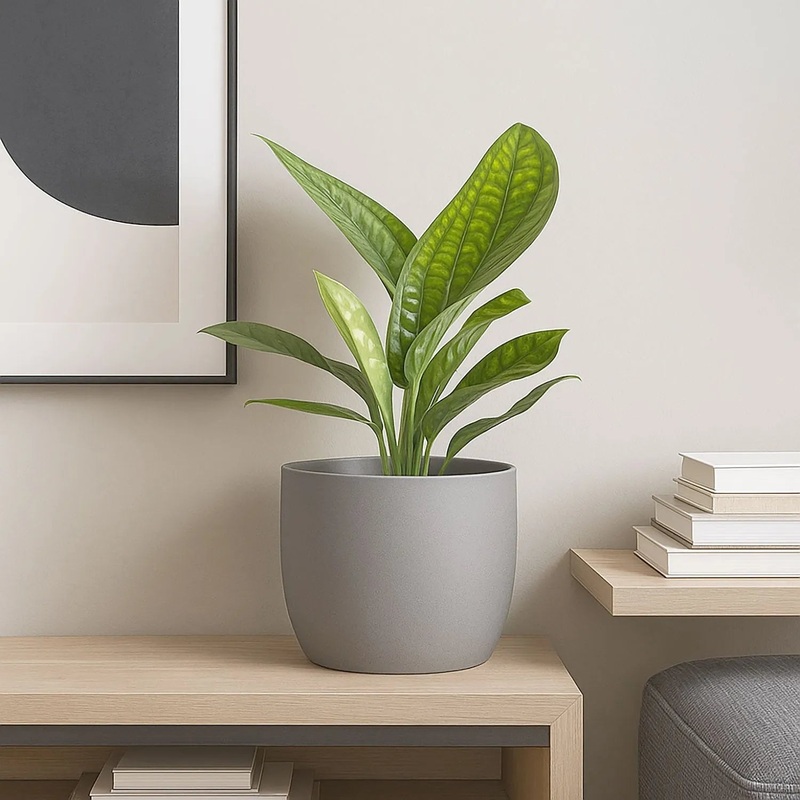
Display Calathea makoyana where its delicate leaf patterns can be admired such as on a console, desk, or side table in bright, filtered light. Pair with plants that have solid-coloured or contrasting foliage, such as Philodendron Imperial Green or Ficus elastica Shivereana, to accentuate its ornate design. It thrives in humid rooms like bathrooms or kitchens and looks stunning in white or pastel ceramic planters that complement its graceful, patterned leaves.