$27.99
$34.99
50% OFF! Hot items selling fast—Grab them before they're gone!
 Unconditional Satisfaction GuaranteeNo Shipping Fees Above 302 Months to Decide. Returns Simplified.
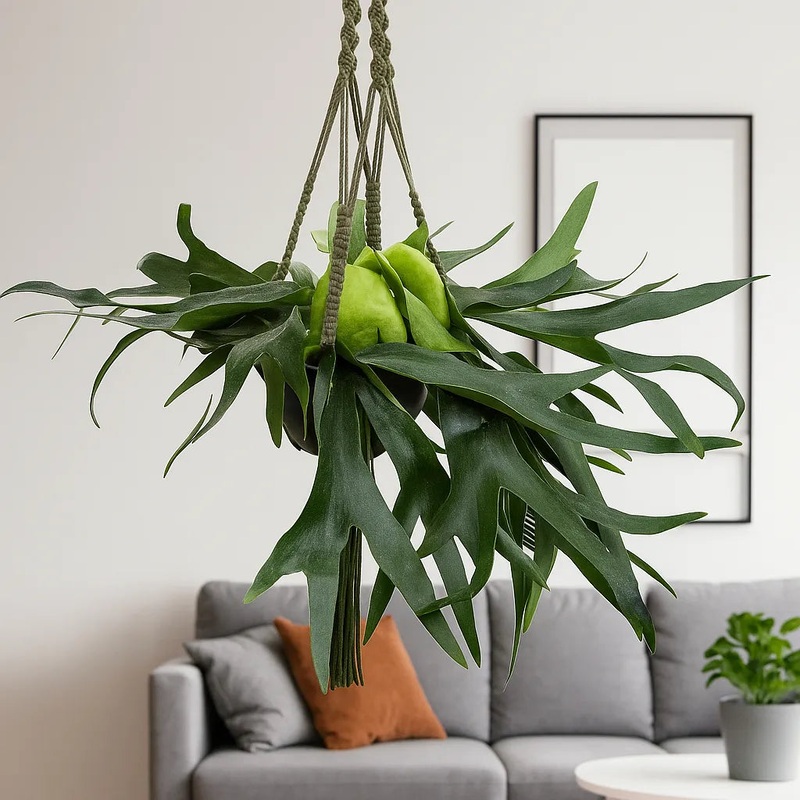
Platycerium bifurcatum, commonly known as the Staghorn Fern, is a striking and architectural epiphytic fern admired for its antler-like fronds and sculptural presence. Native to the rainforests of Australia, New Guinea, and parts of Southeast Asia, this species is a member of the Polypodiaceae family and one of the most iconic ferns used in modern tropical displays and mounted wall gardens.
The plant develops two distinct types of fronds: shield fronds flat, rounded basal leaves that protect the roots and help the plant absorb moisture and fertile fronds, which arch outward like deer antlers. These long, lobed fronds grow in layered whorls, giving the plant its characteristic wild, natural elegance. Over time, Platycerium bifurcatum forms a dense, living sculpture that brings texture and movement to any interior or outdoor space.
Regal, exotic, and effortlessly dramatic, the Staghorn Fern captures the essence of tropical artistry a true statement piece for plant collectors and design enthusiasts alike.
Thrives in bright, indirect light. Filtered sunlight or dappled shade mimics its natural habitat beneath rainforest canopies. Too much direct sunlight can burn the fronds, while insufficient light can stunt growth or cause yellowing. Indoors, position near a bright east- or north-facing window.
Water regularly but moderately, keeping the root ball or mounting medium evenly moist. As an epiphyte, Platycerium bifurcatum does not like sitting in water. For mounted plants, soak the entire mount in water for 1015 minutes once a week, allowing it to drain fully before rehanging. In humid environments, water less frequently. Mist the fronds occasionally to maintain consistent moisture.
Temperature: Prefers warmth between 2028 C; avoid temperatures below 12 C.
Humidity: Enjoys high humidity (6080%) but tolerates moderate household levels. In dry conditions, mist regularly or use a humidifier to prevent frond browning.
If potted, use a loose, free-draining mix, such as sphagnum moss combined with orchid bark and perlite. Mounted specimens do best on wooden boards, cork, or tree fern plaques filled with sphagnum moss around the roots. Secure gently with twine or fishing line until the fern anchors itself naturally.
Feed every 46 weeks during spring and summer with a diluted balanced liquid fertiliser or a foliar spray. Reduce feeding in autumn and winter when growth slows. For mounted plants, a weak fertiliser solution can be added directly to the soaking water.
Do not remove the brown, papery shield fronds they are essential for the plants health and act as natural protection and nutrient storage. Trim only dead or damaged fertile fronds if necessary. Wipe the green fronds gently with a soft, damp cloth to remove dust and enhance their natural sheen.
A slow to moderate grower, Platycerium bifurcatum can reach 6090 cm in width and 80100 cm in height under ideal conditions. Mature plants produce new fronds in layered tiers, creating a dramatic, cascading display. With proper care, it can live for decades, growing increasingly majestic with age.
Brown frond tips: Low humidity or irregular watering.
Yellow fronds: Overwatering or excessive light.
Slow growth: Insufficient light or nutrients.
Pests: Occasionally scale or mealybugs; treat gently with neem oil or insecticidal soap.
Platycerium bifurcatum grows naturally as an epiphyte, anchoring itself to tree trunks and branches in humid forest environments where it collects moisture and nutrients from rainfall and organic debris. Its name derives from the Greek platy (flat) and ceras (horn), referencing the shape of its fronds.
In cultivation, the Staghorn Fern has become a symbol of natural artistry and tropical refinement, often mounted on wooden plaques as living wall dcor. Beyond its striking aesthetic, it also contributes to air purification and adds a sense of tranquillity and organic movement to interior spaces.
Light: Bright, indirect light; avoid harsh direct sun
Water: Keep evenly moist; soak mounted plants weekly and let drain fully
Temperature: 2028 C; avoid below 12 C
Humidity: Moderate to high (6080%)
Soil: Loose, airy mix sphagnum moss, orchid bark, perlite
Feed: Every 46 weeks in spring/summer
Growth: Epiphytic habit, 6090 cm; shield fronds and antler-shaped fertile fronds forming a sculptural display
Toxicity note: Non-toxic to humans and pets, making it suitable for all households.
Display Platycerium bifurcatum as a mounted wall feature or hanging specimen, allowing its sculptural fronds to cascade freely. It pairs beautifully with other rainforest epiphytes such as Asplenium nidus (Birds Nest Fern) or trailing tropicals like Philodendron micans for a layered, natural look. Perfect for bright bathrooms, conservatories, or living walls, the Staghorn Fern transforms any vertical space into a lush, living work of art.