
$149.00
$1.00
50% OFF! Hot items selling fast—Grab them before they're gone!
 Unconditional Satisfaction GuaranteeNo Shipping Fees Above 302 Months to Decide. Returns Simplified.
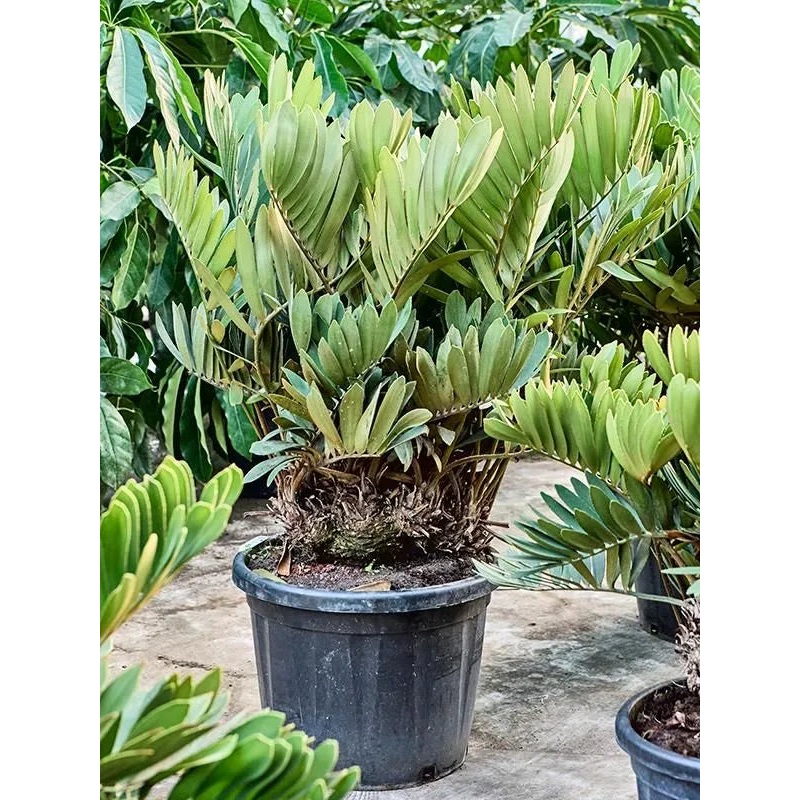
Zamia furfuracea, commonly known as the Cardboard Palm, is an unusual and highly decorative cycad native to Mexico. Despite its common name, it is not a true palm, but belongs to an ancient group of plants dating back to the time of the dinosaurs.
Foliage: Forms a low, spreading rosette of thick, leathery, stiff, fern-like fronds that emerge from a central trunk. The leaflets are oblong, slightly fuzzy to the touch, giving rise to the common name “Cardboard Palm”.
Form: Typically grows to around 6090 cm high with a spread up to 1.5 metres, making it excellent for low-maintenance architectural ground cover or as a statement in containers.
Trunk: A short, partially buried, tuberous trunk acts as a water store, helping it tolerate dry periods.
Cones: As a cycad, it produces cones rather than flowers, with separate male and female plants. Female plants may develop large, decorative cones.
Because of its tough, prehistoric appearance, Zamia furfuracea is often used in subtropical gardens, Mediterranean-style planting schemes, and as a striking feature in pots.
Prefers bright indirect light to full sun.
Outdoors in the UK, it should be placed in the sunniest, most sheltered spot possible during warm months.
Indoors, keep near a bright window with some direct sunlight. Tolerates light shade but grows more slowly.
Not frost hardy.
Must be brought indoors or into a conservatory/greenhouse in autumn if grown outdoors in pots in the UK.
Ideal temperature range is 1530C. Keep above 5C at all times.
Drought-tolerant once established.
Allow the top few centimetres of soil to dry out between watering. Overwatering is the most common cause of problems it is better to be slightly too dry than too wet.
In winter, reduce watering significantly.
Needs excellent drainage. Use a gritty or sandy compost mix, such as cactus compost mixed with extra perlite or grit.
Avoid heavy soils that hold water around the roots.
Feed lightly once a month during spring and summer with a balanced liquid fertiliser diluted to half strength.
No feeding is needed in autumn and winter.
Very low maintenance.
Remove old, yellowing fronds at the base to tidy the plant.
Generally pest-free.
Indoors, may occasionally see scale insects on stems or leaves wipe off with a damp cloth or use horticultural soap.
Excellent in large pots, allowing it to be moved outdoors in summer and protected over winter.
Use a terracotta pot with drainage holes, filled with free-draining cactus compost.
Raise the pot on feet to ensure excess water drains away.